


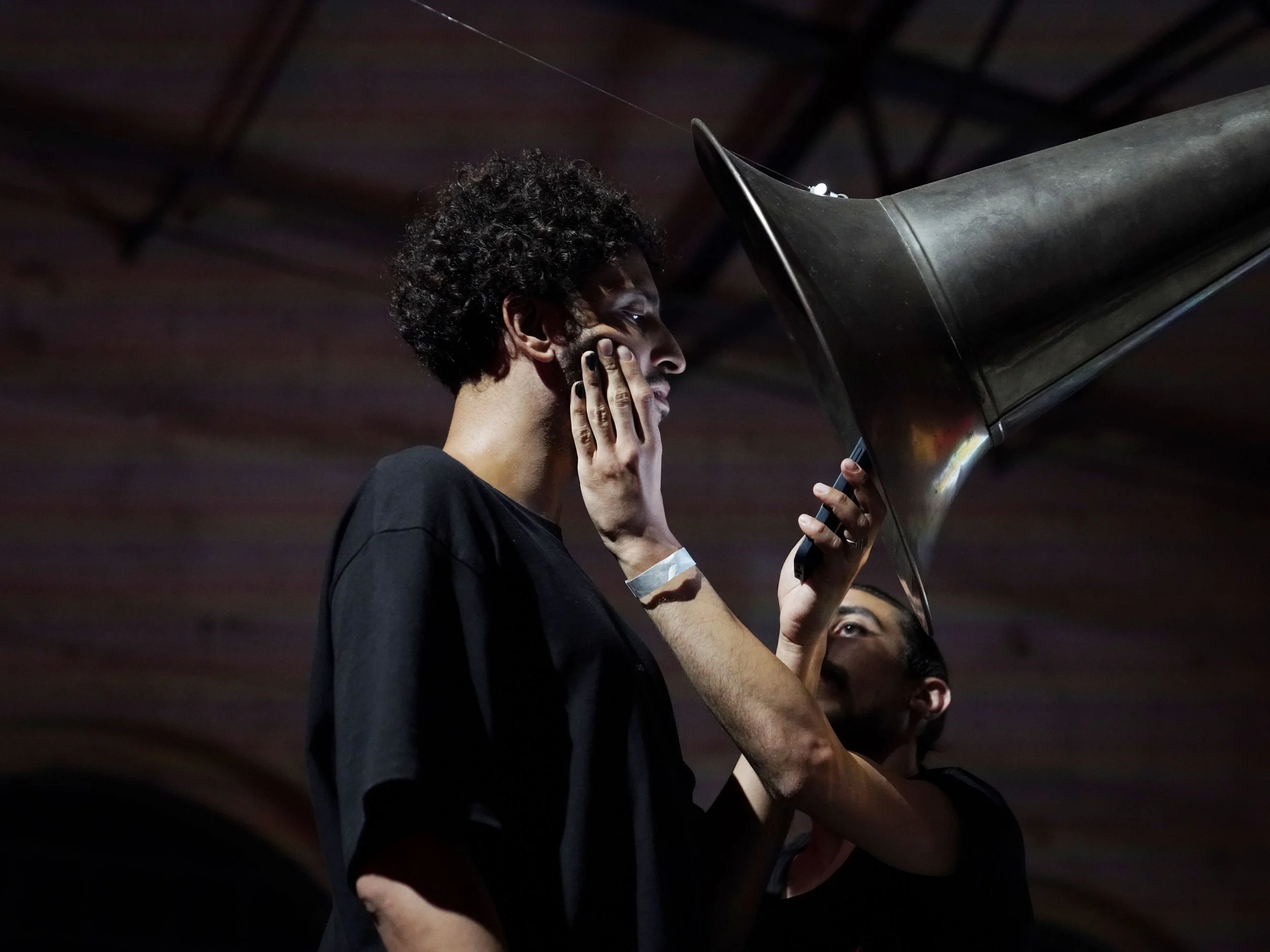

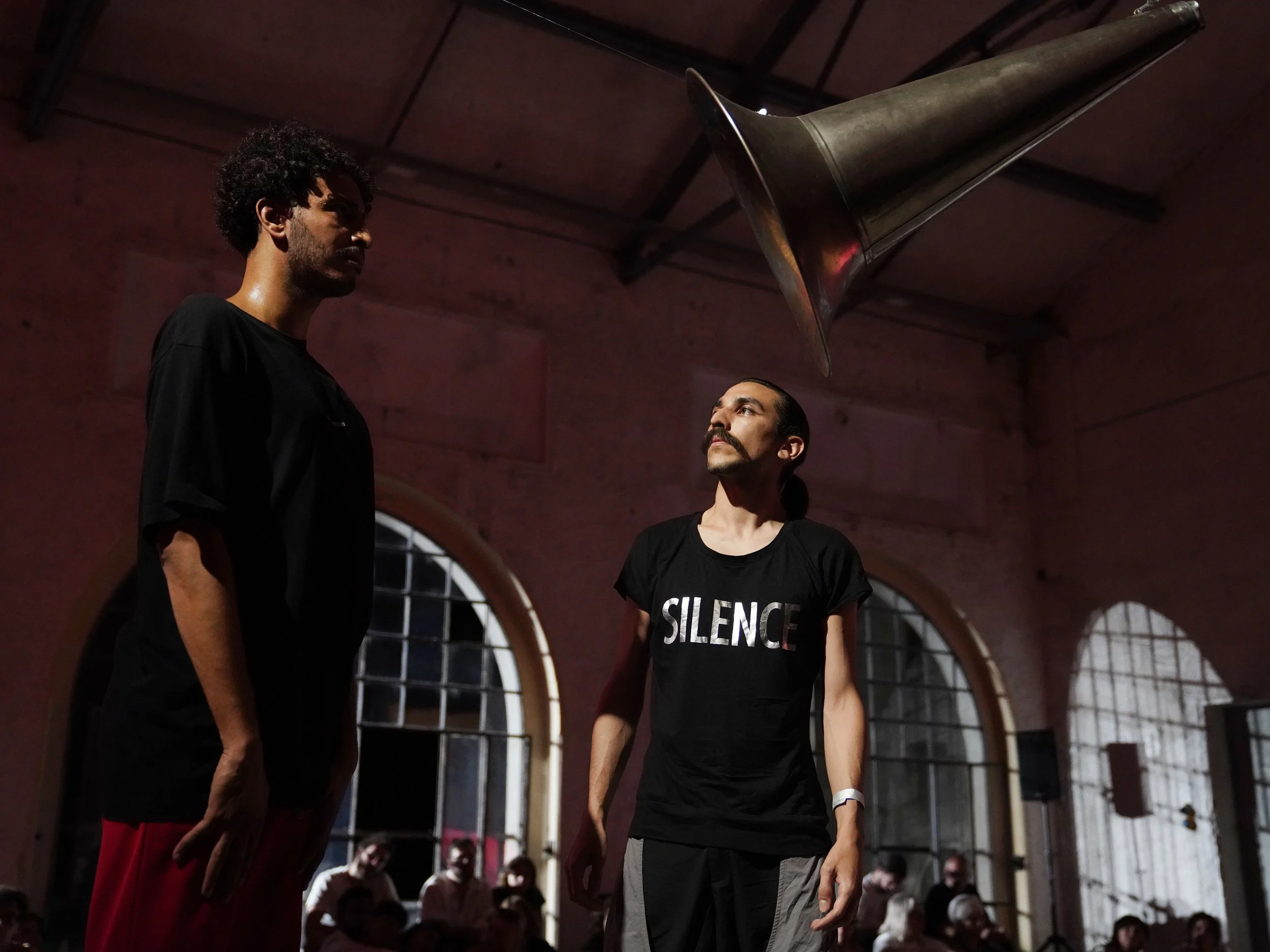

“Each of the consciousnesses on stage has made the leap, from nothingness to justified Being. From unjustified being to Nothingness, whence the finite appearance of the expression” — Frantz Fanon, Parallel Hands.
The story of the protagonist Sadek Ben Rachid Haj Youssef (Sadok), a Tunisian poet, singer and prisoner of the First World War, overlaps fact and fiction. It is based on research conducted between the archive collections of the Berliner Phonogramm-Archiv, the Lautarchiv Berlin, Frantz Fanon's play—manuscript 'Parallel Hands' (1949) and in different counter-archives. Sadok was a soldier in the North African forces, recruited by the French (1914) and used in the major battles of Europe before being captured by the Germans (1915). He was 37 years old when he made several recordings at the Half-Moon POW camp at Wünsdorf (south of Berlin). On 30 May 1916, at 1.15 in the morning; Sadok stood in front of a horn and sang three war poems. Ltaief's performance research-based project «The Concretely WE: Voices From Within The Camp» investigates and retraces the early phonographic sound archives commissioned and classified in the 1910s. These archives include prompt ethnographic recordings made by the Prussian Phonographic Commission established by Wilhelm Doegen, with a group of philologists, linguists and ethnomusicologists who captured the voices of colonial subjects imprisoned in war camps across Germany, producing the following 1,650 shellac records between 1915 and 1918.Fanon's comprehension of colonial violence paralleled his methods of psychiatry, equating the effects of colonialism with the causes of mental illness; a society that has created a disease that can only be eradicated by dismantling its neurological causes; colonialism and its aftermath. Following Fanon's psychoanalytic and theatrical thought, the performance aims to decipher the consequences of colonialism, the apparatus of capture, and the understanding of alienation that have produced multiple forms of relational illness. Sadok's existential sonic refusal—poem comes as an autobiographical counter-narrative, a form of resistance or rather survival that acknowledges and raises the notions of ethics and aesthetics for those who usually impersonates the voice’s subject. Through monologues, visual testimonies, movement and listening forms, the choreographic and sonic acts are evoked, staged and mediated in a captivating yet liberating language.
You can hear Sadok's voice here
https://phonotheque.cmam.tn/archives/items/PrisonniersTunisiens_1916-1918_005/
In partnership with Ennejma Ezzahra Tunis and Lautarchiv der Humboldt-Universität zu Berlin: the recordings were transferred to the Tunisian National Sound Archive by Humboldt University Berlin's Lautarchiv in January 2025 as part of the Towards Sonic ReSocialisation' project, funded by the Deutsches Zentrum Kulturgutverluste (German Foundation for Lost Cultural Property). The collection comprises 445 historical recordings of voices and music that were recorded by the Phonographic Commission (Königlich Preußische Phonographische Kommission) during the First World War (1914-1918) with French colonial soldiers from North Africa and several sub-Saharan African countries in the Muslim prisoner-of-war camp in Zossen-Wünsdorf. .
These are wax sound recordings of prisoners at the Zossen-Wünsdorf camp during the First World War (1914–1918) - تسجيلات أسرى الحرب العالمية الأولى معسكر زوسين فونسدورف phonotheque.cmam.tn/archives/corpus/Prisonniers_Zossen-Wunsdorf ألمانيا
